Loading content…
React + Node + PostgreSQL
Express + PostgreSQL in Production
Master input validation, JWT token lifecycles, connection pooling, CORS, rate-limiting, and error-handling in Express production apps
Tags:
expressnodejspostgressecuritybackend
85 minutes
Writing a quick local server is easy, but running an Express backend connected to a PostgreSQL database at scale requires robust input validation, hardened security configurations, database connection stability, and clean error handling. Let's learn the exact patterns used in modern enterprise APIs.
1. Request Input Validation (Zod)
In production, never trust user input. Client-side validation can easily be bypassed by sending raw HTTP requests. Express endpoints must validate request parameters, query strings, and body JSON before performing database queries.
Using Zod, we can define schemas and parse requests cleanly, returning structured validation errors.
Step 1: Create a Validation Middleware
typescript
import { Request, Response, NextFunction } from "express";
import { AnyZodObject, ZodError } from "zod";

export const validate = (schema: AnyZodObject) => {
  return async (req: Request, res: Response, next: NextFunction): Promise<void> => {
    try {
      // Validate body, query, and params against the schema
      const parsed = await schema.parseAsync({
        body: req.body,
        query: req.query,
        params: req.params,
      });

      // Assign parsed values back to req
      req.body = parsed.body;
      req.query = parsed.query;
      req.params = parsed.params;

      next();
    } catch (error) {
      if (error instanceof ZodError) {
        res.status(400).json({
          status: "fail",
          errors: error.errors.map(err => ({
            field: err.path.join("."),
            message: err.message
          }))
        });
        return;
      }
      next(error);
    }
  };
};
Step 2: Define Schema and Route
typescript
import express from "express";
import { z } from "zod";
import { validate } from "./middleware/validate";

const router = express.Router();

const createUserSchema = z.object({
  body: z.object({
    name: z.string().min(2, "Name must be at least 2 characters long"),
    email: z.string().email("Invalid email address"),
    password: z.string().min(8, "Password must be at least 8 characters long"),
  }),
});

router.post("/users", validate(createUserSchema), async (req, res) => {
  // Safe: req.body is validated and typed!
  const { name, email, password } = req.body;

  // Insert into PostgreSQL database...
  res.status(201).json({ success: true });
});
2. JWT Authentication Lifecycle & Security
JWTs (JSON Web Tokens) are standard for API authorization, but storing them insecurely makes your app vulnerable to security exploits.
Secure Token Lifecycles
- Access Token: Short-lived (e.g., 15 minutes). Used to access endpoints.
- Refresh Token: Long-lived (e.g., 7 days). Used to request a new Access Token. Stored in a database to allow token revocation if compromised.
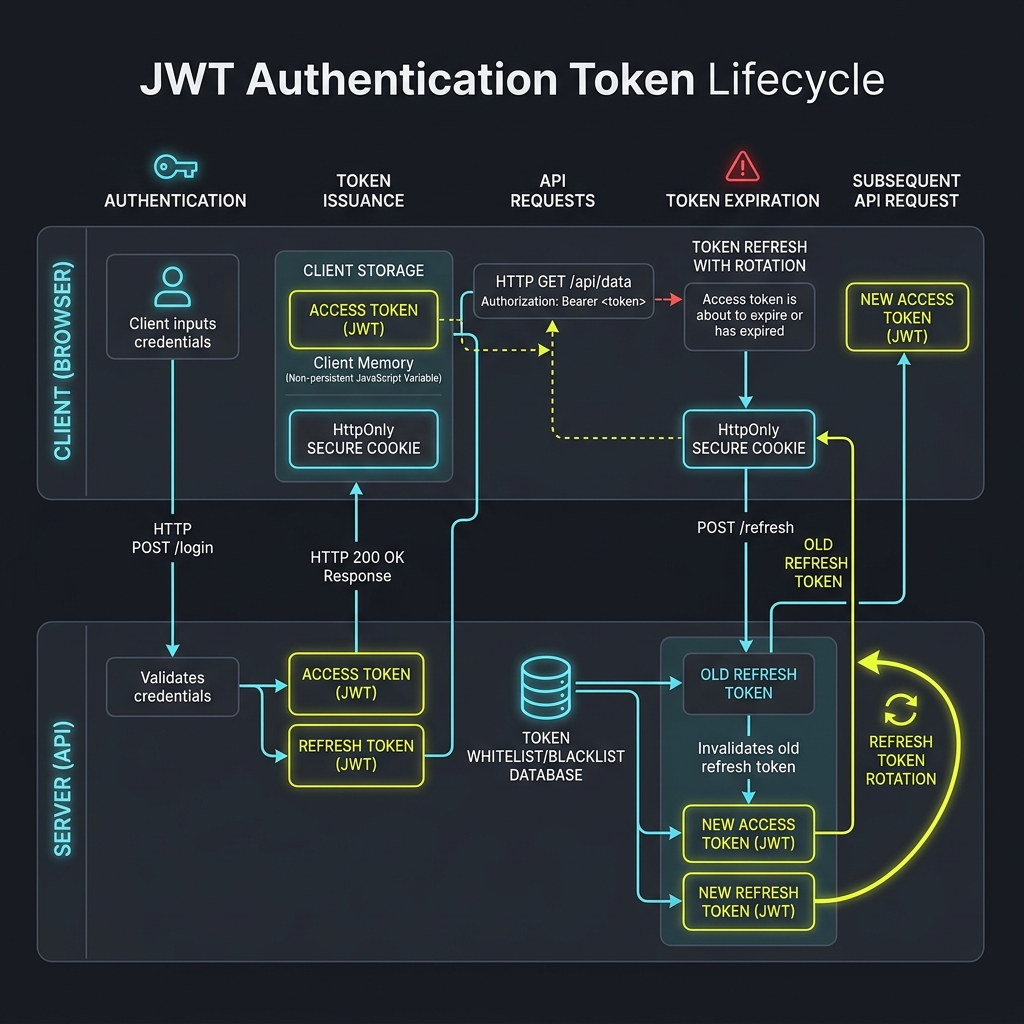 JWT Authentication Token Rotation Flow
HttpOnly Cookies (Defense Against XSS)
Never store JWTs in local storage (
localStorage) or session storage. Storing tokens in client memory makes them vulnerable to Cross-Site Scripting (XSS). Instead, store tokens in Secure, HttpOnly, SameSite cookies.typescript
import { Response } from "express";
import jwt from "jsonwebtoken";

export const sendTokens = (res: Response, userId: string) => {
  const accessToken = jwt.sign({ userId }, process.env.JWT_ACCESS_SECRET!, { expiresIn: "15m" });
  const refreshToken = jwt.sign({ userId }, process.env.JWT_REFRESH_SECRET!, { expiresIn: "7d" });

  // Store access token in HttpOnly cookie
  res.cookie("accessToken", accessToken, {
    httpOnly: true,
    secure: process.env.NODE_ENV === "production", // HTTPS only in prod
    sameSite: "strict", // Prevent CSRF attacks
    maxAge: 15 * 60 * 1000, // 15 mins
  });

  // Store refresh token in a separate HttpOnly cookie
  res.cookie("refreshToken", refreshToken, {
    httpOnly: true,
    secure: process.env.NODE_ENV === "production",
    sameSite: "strict",
    maxAge: 7 * 24 * 60 * 60 * 1000, // 7 days
  });
};
Common Pitfall
When using cookies for auth, your app becomes vulnerable to Cross-Site Request Forgery (CSRF). Always set
sameSite: "strict" or sameSite: "lax", and use a anti-CSRF token check for modifying state endpoints (POST/PUT/DELETE) if serving a separate domain.3. Database Connection Pooling (pg.Pool)
Opening a new database connection on every incoming HTTP request is an expensive operation that will quickly exhaust your PostgreSQL resources under high traffic.
Always use a Connection Pool (
pg.Pool) which creates a cache of reusable database connections.typescript
import { Pool } from "pg";

const pool = new Pool({
  connectionString: process.env.DATABASE_URL,
  max: 20, // Max number of concurrent clients in the pool
  idleTimeoutMillis: 30000, // Close idle clients after 30 seconds
  connectionTimeoutMillis: 2000, // Return an error if connection takes > 2s
});

export const query = (text: string, params?: any[]) => {
  return pool.query(text, params);
};

// Check pool error handling
pool.on("error", (err) => {
  console.error("Unexpected error on idle database client", err);
});
Senior Developer Wisdom
Setting the pool size (
max) requires careful balance. A good starting formula is: ((Max Database Connections) / (Number of Server Instances)) - 5. Leaving room ensures other tools (e.g. database migrations, backup scripts) can connect without encountering errors.4. CORS and Rate Limiting Policies
CORS Configuration
Allowing all domains (
cors(*)) is a security hazard in production. Restrict cross-origin requests to trusted domains only.typescript
import cors from "cors";

const allowedOrigins = [
  "https://codenivra.io",
  "https://admin.codenivra.io"
];

const corsOptions: cors.CorsOptions = {
  origin: (origin, callback) => {
    if (!origin || allowedOrigins.indexOf(origin) !== -1) {
      callback(null, true);
    } else {
      callback(new Error("Blocked by CORS policy"));
    }
  },
  credentials: true, // Allow cookies to be sent along with requests
  optionsSuccessStatus: 200,
};

app.use(cors(corsOptions));
Rate Limiting
Prevent Denial of Service (DoS) and brute force attacks by limiting requests from a single IP address using
express-rate-limit.typescript
import rateLimit from "express-rate-limit";

export const globalLimiter = rateLimit({
  windowMs: 15 * 60 * 1000, // 15 minutes
  max: 100, // Limit each IP to 100 requests per window
  message: {
    status: "fail",
    message: "Too many requests from this IP, please try again later."
  },
  standardHeaders: true, // Return rate limit info in the headers
  legacyHeaders: false, // Disable the X-RateLimit-* headers
});

app.use("/api/", globalLimiter);
5. Global Error Handling Middleware
A clean backend must separate business logic from error response formatting. Express should capture errors centrally to log them, alert administrators, and return standard, non-sensitive payloads to the client.
Step 1: Create a Custom AppError Class
typescript
export class AppError extends Error {
  public readonly statusCode: number;
  public readonly isOperational: boolean;

  constructor(message: string, statusCode: number) {
    super(message);
    this.statusCode = statusCode;
    // Operational errors represent expected failures (validation, auth failures)
    // Programmer errors represent bugs (syntax, database exceptions)
    this.isOperational = true;

    Error.captureStackTrace(this, this.constructor);
  }
}
Step 2: Centralized Express Error Middleware
typescript
import { Request, Response, NextFunction } from "express";
import { AppError } from "./errors/AppError";

export const errorHandler = (
  err: Error | AppError,
  req: Request,
  res: Response,
  next: NextFunction
): void => {
  const statusCode = "statusCode" in err ? err.statusCode : 500;
  const isOperational = "isOperational" in err ? err.isOperational : false;

  // 1. Log all errors internally
  console.error("ERROR 💥:", err);

  // 2. Format response based on error type
  if (isOperational) {
    res.status(statusCode).json({
      status: "fail",
      message: err.message,
    });
  } else {
    // Programmer or Database error: Don't leak details to clients
    res.status(500).json({
      status: "error",
      message: "Something went wrong on our end.",
    });
  }
};
Step 3: Register in Application Root
typescript
import express from "express";
import { errorHandler } from "./middleware/errorHandler";
import { AppError } from "./errors/AppError";

const app = express();

app.get("/api/user-details", async (req, res, next) => {
  try {
    const user = await getUserFromDb(req.query.id);
    if (!user) {
      return next(new AppError("No user found with that ID", 404));
    }
    res.json(user);
  } catch (error) {
    next(error); // Forward programmer error to error handler middleware
  }
});

// Register errorHandler at the very end of app middleware chain!
app.use(errorHandler);
Pro Tip
Always capture unhandled promise rejections and uncaught exceptions at the Node process level. If a database connection fails and is unhandled, shut down the server gracefully so your process manager (like PM2 or Kubernetes) can restart the instance:
process.on("unhandledRejection", (err) => {
console.error("UNHANDLED REJECTION! Shutting down...");
console.error(err);
server.close(() => process.exit(1));
});
Express + Postgres Production Checklist
Key Takeaways
- Never rely on client-side safety checks; always validate inputs on the server.
- HttpOnly Cookies shield authorization tokens from client-side script access.
- Database Connection Pools are mandatory to prevent resource crashes.
- Global Error Handlers block core system traces (e.g. database schema details) from being leaked to users.
Have you finished this guide?
Marking it complete updates your roadmap progress percentage.